Leave Your Message
-
Phone
-
E-mail
-
Whatsapp
China Top Bathroom Filter Shower Head Suppliers
Choosing a reliable Bathroom Filter Shower Head supplier in China requires more than comparing prices. Buyers need evidence, manufacturing experience, and clear performance data. A polished product photo proves very little.
Dr. Joseph Cotruvo, a recognized water-quality expert, has stated, “Safe water is a public-health priority.” This principle also matters in the bathroom. A shower filter may reduce chlorine, odors, sediment, or selected impurities. Its results depend on the filter media, water pressure, contact time, and replacement schedule.
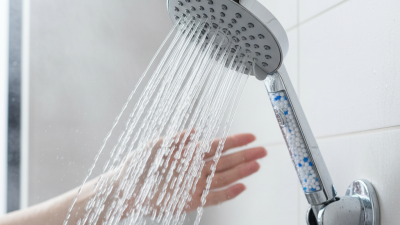
Look for suppliers using activated carbon, KDF media, calcium sulfite, ceramic balls, or layered filtration systems. Each material has different strengths. Carbon can improve odor. KDF may support chlorine reduction. No cartridge removes everything.
That detail matters.
Leading Chinese manufacturers often provide factory audits, material declarations, batch records, and laboratory reports. Ask whether testing follows recognized standards, such as NSF/ANSI methods, where applicable. Also check thread sizes, flow performance, cartridge life, packaging quality, and after-sales support.
A dependable supplier should explain limits without exaggerated promises. It should show test conditions, not only impressive percentages. This is where some product pages become unclear.
Price still matters. However, a cheap housing with an expensive replacement cartridge may create higher ownership costs. Sample testing can reveal leakage, weak seals, unstable flow, or premature discoloration.
The best supplier is not always the largest factory. It is the partner that answers technical questions directly, documents its claims, and improves after receiving criticism. A little uncertainty remains, because local water conditions vary. Responsible sourcing acknowledges that reality.
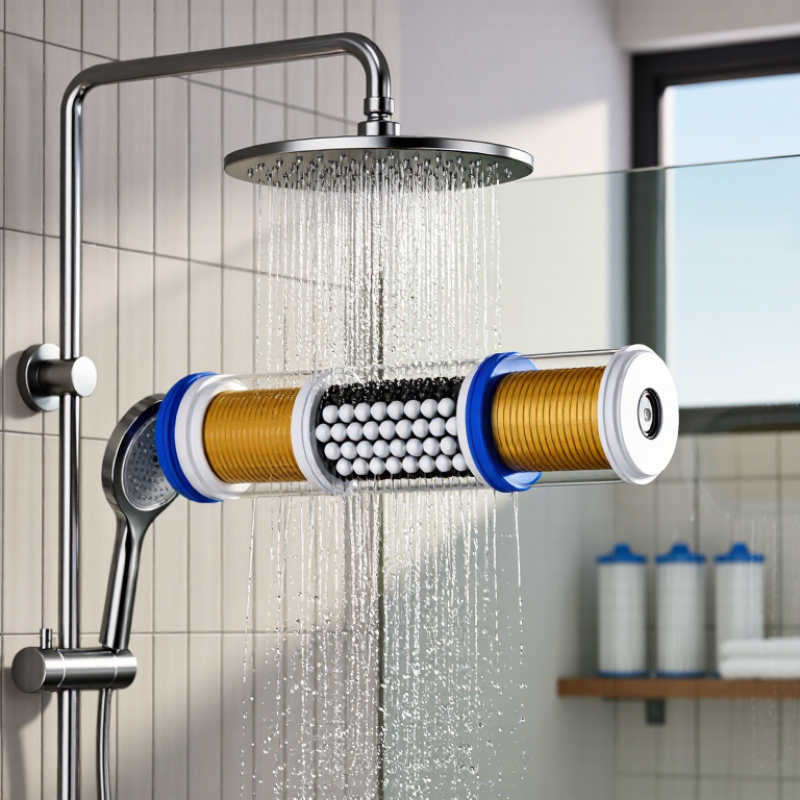
China’s bathroom filter shower heads come in several practical types. Activated-carbon models target free chlorine, odors, and some organic compounds. NSF/ANSI 177 focuses specifically on chlorine reduction in shower filtration systems. This makes carbon filters suitable for treated municipal water, but not for every contaminant. They do not replace drinking-water purification.
Vitamin C shower heads use ascorbic acid media. They can reduce chlorine quickly, especially in warm water. However, cartridge life depends on flow rate and water chemistry. KDF media uses copper-zinc alloys and is often combined with carbon. It may support chlorine reduction and scale control. Ceramic and mineral-ball models are also common in Chinese online markets. Their performance varies widely, so vague “detox” claims deserve caution. China’s GB 5749-2022 standard covers drinking-water quality, not automatic shower-filter performance.
Tips: Check certification, replacement intervals, and tested reduction claims. Measure your connector before ordering. A five-minute shower can expose skin and hair to heated water, so stable flow matters. The WHO and UNICEF JMP 2023 report states that 2.2 billion people lacked safely managed drinking water in 2022. That figure shows why water treatment matters, but shower filters address a narrower use. In practice, carbon cartridges may clog early in areas with sediment. I would not treat one filter as a complete solution. Testing local water first is the more reliable choice.
| Shower Head Filter Type | Primary Filter Media | Typical Water-Quality Function | Common Housing Format | Typical Replacement Interval | Main Advantages | Important Sourcing Considerations |
|---|---|---|---|---|---|---|
| Sediment-Mesh Filter Shower Head | Stainless-steel mesh or washable polymer screen | Traps visible particles such as rust flakes, sand and pipe debris; it does not normally remove dissolved minerals. | Built-in screen or compact inline cartridge chamber | Screen cleaning: approximately every 1–3 months, depending on water quality | Low running cost, washable element and relatively low pressure loss | Confirm mesh rating, cleaning access, corrosion resistance and seal quality. |
| Activated Carbon Filter Shower Head | Granular activated carbon or carbon block | May reduce chlorine taste and odor and some organic compounds when correctly designed and tested; performance varies by contact time and flow rate. | Handheld head with replaceable cartridge or inline filter body | Usually about 2–6 months, subject to water quality and usage | Improves perceived water odor and offers a widely available cartridge format | Request chlorine-reduction test data, carbon grade, cartridge capacity and rated flow. |
| KDF-Media Filter Shower Head | Copper-zinc KDF-type media, often combined with sediment or carbon layers | Can support chlorine reduction and control of certain dissolved metals under specified test conditions; it is not a universal contaminant remover. | Multi-layer inline cartridge or transparent filter chamber | Approximately 3–6 months in typical household use | Suitable for multi-stage designs and relatively warm shower-water conditions | Verify media weight, flow-rate test results, pressure drop and contaminant-specific claims. |
| Calcium Sulfite Filter Shower Head | Calcium sulfite granules or pellets | Primarily designed to help reduce free chlorine, especially in warm water; it does not generally soften hard water. | Compact replaceable cartridge inside an inline body or shower handle | Commonly about 3–6 months, depending on chlorine level and water consumption | Compact design and useful performance at shower-water temperatures | Ask for chlorine-capacity data, operating-temperature range and safe media containment. |
| Multi-Stage Filter Shower Head | Combination of sediment mesh, activated carbon, KDF-type media or calcium sulfite | Provides several treatment functions in one unit, depending on the selected media and validated performance data. | Inline cartridge body, handheld filter head or wall-mounted filter unit | Usually about 2–6 months; the first-stage sediment load can shorten service life | Flexible configuration and broader product-positioning options | Check the order of media layers, replacement availability, flow rate and total pressure loss. |
| Vitamin C Filter Shower Head | Ascorbic-acid or vitamin-C-based cartridge | Can chemically neutralize free chlorine under appropriate dosage and contact conditions; it does not remove hardness or all dissolved contaminants. | Decorative inline cartridge, handheld filter or replaceable fragrance-style pod | Often about 1–3 months, depending on cartridge size, usage and chlorine concentration | Compact appearance and fast-acting chlorine-treatment concept | Confirm ingredient stability, dosage, shelf life, safety documentation and odor claims. |
| Mineral-Ball or Ceramic-Media Shower Head | Ceramic balls, tourmaline-type media or other mineral beads | Generally marketed for water-conditioning or sensory benefits; these materials should not be treated as proven substitutes for certified contaminant filtration without test evidence. | Transparent cartridge chamber or decorative shower handle | Commonly 6–12 months, based on media condition and product instructions | Visual appeal, compact construction and simple cartridge replacement | Require independent evidence for any chlorine, heavy-metal, pH or “softening” claims. |
| High-Flow Inline Filter Shower System | Large-capacity sediment and carbon cartridge, optionally combined with other media | Designed to maintain filtration at higher household flow rates; actual reduction performance depends on cartridge size and contact time. | Wall-mounted inline housing installed between the shower arm and hose | Approximately 3–12 months, depending on capacity and water consumption | Higher cartridge capacity and easier service access than many integrated heads | Confirm connector size, maximum operating pressure, leak testing and replacement-cartridge logistics. |